
Improving communication across your enterprise can boost the pace and growth of your business. It’s an investment in the one thing that every employee spends the majority of their workday doing. But one core problem stands in the way of achieving operational excellence: Not everyone is on an equal playing field when it comes to communicating effectively. In any organization, employees have varying educational backgrounds, primary languages, learning styles, language proficiencies, and, now, degrees of AI literacy. If your employees are not equipped with the necessary skills or tools to communicate effectively, poor communication can quickly create an invisible drag on your business performance.
The Ultimate Guide
to Business Communication
Knowledge workers spend
88% of the workweek communicating
"Communication impacts every aspect of the workplace. Leaders report effective communication drives significant business benefits, including increased productivity, heightened customer satisfaction, and improved brand reputation. Many have even said that effective communication has directly impacted the bottom line by helping to close successful business deals and reduce costs."
The Communication
Effect

Business Impact

Externally, effective communication delivers the personalized and attentive support that customers desire and demand. Leaders say that effective communication has increased customer satisfaction by helping deliver timely and personalized support, making customers feel heard, and strengthening customer trust. The significance of effective communication is undeniable, impacting not only the internal dynamics of a workforce but also shaping external interactions with customers.
1. 2024 State of Business Communication
Leaders report positive impacts of effective communication for their business1

64%
Increased productivity
43%
Gained new business
51%
Increased customer satisfaction
45%
Improved
brand reputation
33%
Lowered costs
Customer Impact

Lastly, let’s not underestimate the benefits that effective communication has on a company’s most important resource: its employees. Knowledge workers say that effective communication boosts their overall work satisfaction, improves relationships, and increases their confidence at work. Moreover, it impacts job performance. Workers say that good communication helps them to be more productive and reduces the daily stresses that they take on in their jobs.
1. 2024 State of Business Communication
Leaders report positive impacts of effective communication for their customers1
64%
Timely support
58%
More attentive
support
64%
Greater clarity
64%
Feel heard
54%
Personalized support
Work Impact

While no business leader or knowledge worker would disagree that effective communication is preferred, the challenge is that it can be hard to understand what effective communication looks like and how to achieve it consistently in our increasingly dynamic workplaces.
1. 2024 State of Business Communication
Leaders report positive impacts of effective communication for at work1
64%
Timely support
58%
More attentive
support
64%
Greater clarity
64%
Feel heard
54%
Personalized support
Innovative professionals have been using generative AI to reshape the landscape of work communication by automating tasks, enhancing personalization, streamlining research, overcoming language barriers, and producing original, tailored content and images at scale.
How Generative AI Impacts Workplace Communication

Workers using gen AI say:1
Using generative AI helps me avoid miscommunications at work.

I believe generative AI tools can help me communicate more effectively at work.
Generative AI has transformed the way I communicate at work.
1. 2024 State of Business Communication
To understand how to communicate well, we have to understand the various dimensions of communication that define the workplace. Each workplace communication, from a Slack message to a PowerPoint slide to a customer email, requires a different mix of considerations depending on audience, format, and intent. This adds an additional layer of complexity to getting work done.
The Dimensions
of Business Communication
Who you’re talking to


Definition


Internal
External
When to use
What to be aware of
Interactions between team members, including leadership
Use to share information and updates and foster teamwork and culture
Can easily oversaturate, leading to information overload
Interactions between employees and customers, clients, and the public
Use to share messages that create a positive public brand and reputation
Miscommunication, which can have a lasting negative impact on a company’s success and reputation and on consumer trust
Type
Upward
Definition
When to use
Definition
When direct reports reach out to managers or when managers reach out to top-level executives
Useful for leadership to keep a finger on the pulse of what’s happening on the ground floor
Can be successful only if there is trust and openness
When executives reach out to managers or when managers connect with direct reports
Use to quickly disseminate necessary information, tasks, and feedback
Can be a slow process, especially when information must flow through multiple levels of hierarchy
Type
Downward
Lateral
When peers interact
Use to collaborate, share information, solve problems, and coordinate tasks between team members
The more casual, informal nature may lead to issues with authority, tone, or accountability
One-to-one
One to many
Definition
When to use
What to be aware of
Interactions between two individuals
Use for personalized interactions like giving feedback in performance reviews
Requires a tailored approach to address individual concerns and foster trust
Communication from one sender to multiple recipients
Use when disseminating information to a large audience, as in company-wide announcements or marketing campaigns
Presents a potential for information overload and therefore requires clear, concise messaging to ensure engagement
Type
In-person
Definition
When to use
Definition
Face-to-face, physical interactions
Use for sensitive discussions or team- and culture-building exercises
Requires staying aware of nonverbal cues like body language
Communication that occurs between individuals who are not physically present with each other
Use when teammates are dispersed across locations and time zones
Technological issues can impede effective communication
Type
Remote
Hybrid
Interactions that involve both in-person and remote participants
Use when some team members are remote and others are in person
Need to ensure both in-person and remote parties can participate equally
Written
Definition
When to use
Definition
Communication conveyed through text, such as emails, blogs, ebooks, reports, proposals, and presentations
Use for async communication, recordkeeping, and knowledge sharing
Requires careful attention to clarity, tone, and grammar to ensure effectiveness
Communication conveyed through spoken words, including face-to-face conversations, meetings, phone calls, and video conferences
Use when giving feedback, providing clarification, or discussing sensitive or personal topics
Can create misunderstandings without clear articulation and active listening; not preferred by everyone, including neurodivergent persons
Type
Verbal
Visual
Communication conveyed through images, including sign language, presentations, charts, videos, and illustrations
Use to convey complex information quickly and effectively, allowing people to grasp complex concepts more easily
Has the potential to create misinterpretation or ambiguity
Synchronous
Asynchronous
Definition
When to use
What to be aware of
Communication that happens in real-time, allowing for immediate responses
Use when you want to ensure consistency, clarity, and adherence to organizational standards
Requires active listening and participation to be effective
Communication that does not require real-time interaction, allowing for flexibility in response times
Useful when building relationships, promoting camaraderie, and facilitating the exchange of ideas
Could cause delays in decision-making and requires clear documentation to ensure continuity
Type
Formal
Informal
Definition
When to use
What to be aware of
Communication conveyed through official channels established by the organization, such as company policies, procedures, official announcements, press releases, and reports
Use for real-time collaboration, such as virtual meetings or phone calls
Can create barriers to effective interactions and collaboration within the organization
Casual and unofficial interactions among employees, such as Slack messages and in-office or casual Zoom conversations
Use for flexible communication where immediate response isn’t required, as with email or project management tools
Can lead to the spread of inaccurate information if not managed effectively
Type
Knowledge sharing
Definition
When to use
Definition
The dissemination of information, decisions, and context across an organization to enhance individual and collective understanding
Use to bring employees up to speed and ensure everyone understands organizational practices, systems, and culture
Inaccurate, out-of-date, or hard-to-access communication can spread misinformation or limit the use of the correct information
Communication between team members and leaders used to ensure everyone understands intended goals, strategies, and tactics
Use to reinforce decisions, changes, and strategic objectives to get everyone on the same page
Ambiguous or untimely communication can create a false sense of alignment, driving work into conflicting directions
Type
Alignment
Decision-making
Essential communication designed to remove blockers and move work forward
Use to gather insights and reach consensus that drives productivity
Excluding key individuals or failing to include necessary context can lead to uninformed decisions, and poor outcomes
Project management
Definition
When to use
Definition
Communication that involves coordinating tasks, resources, and stakeholders to achieve specific objectives
Use to plan, execute, and monitor projects and keep stakeholders informed
Ambiguity in task assignments, timelines, or scope can create unnecessary bottlenecks and cause missed deadlines
Communication that facilitates teamwork, idea sharing, and achieving shared goals
Use when multiple perspectives or skills are needed
Without communication that evokes psychological safety, even a collaborative setting can result in limited productive participation
Type
Collaboration
Requesting action
Communication that is intended to initiate specific and prompt action
Use to ensure the completion of tasks when immediate action is required
Missing specifics, context, or timelines can result in incorrect action or inaction
Business Communication Styles
Audience
Business Communication Styles
Direction
Business Communication Styles
Weight
Business Communication Styles
Environment
Business Communication Styles
Format
Business Communication Styles
Timing
Business Communication Styles
Tone
Business Communication Styles
Intent
Business Communication Styles
Intent (continued)
Business communication happens across a very fragmented landscape of channels and tools. Okta’s Businesses at Work report states that large companies use over 200 tools to support their business. With each tool bringing its own set of notifications, rules of engagement, and context requirements, professionals now face communication challenges like information and channel overload. Most business leaders (84%) and knowledge workers (70%) report communicating across more channels at work in the past twelve months. Over half of professionals (55%) say the constant flow of notifications makes it hard to concentrate on important tasks, and 47% feel unsure about choosing the right channel to communicate information.

The Communication Tech Stack
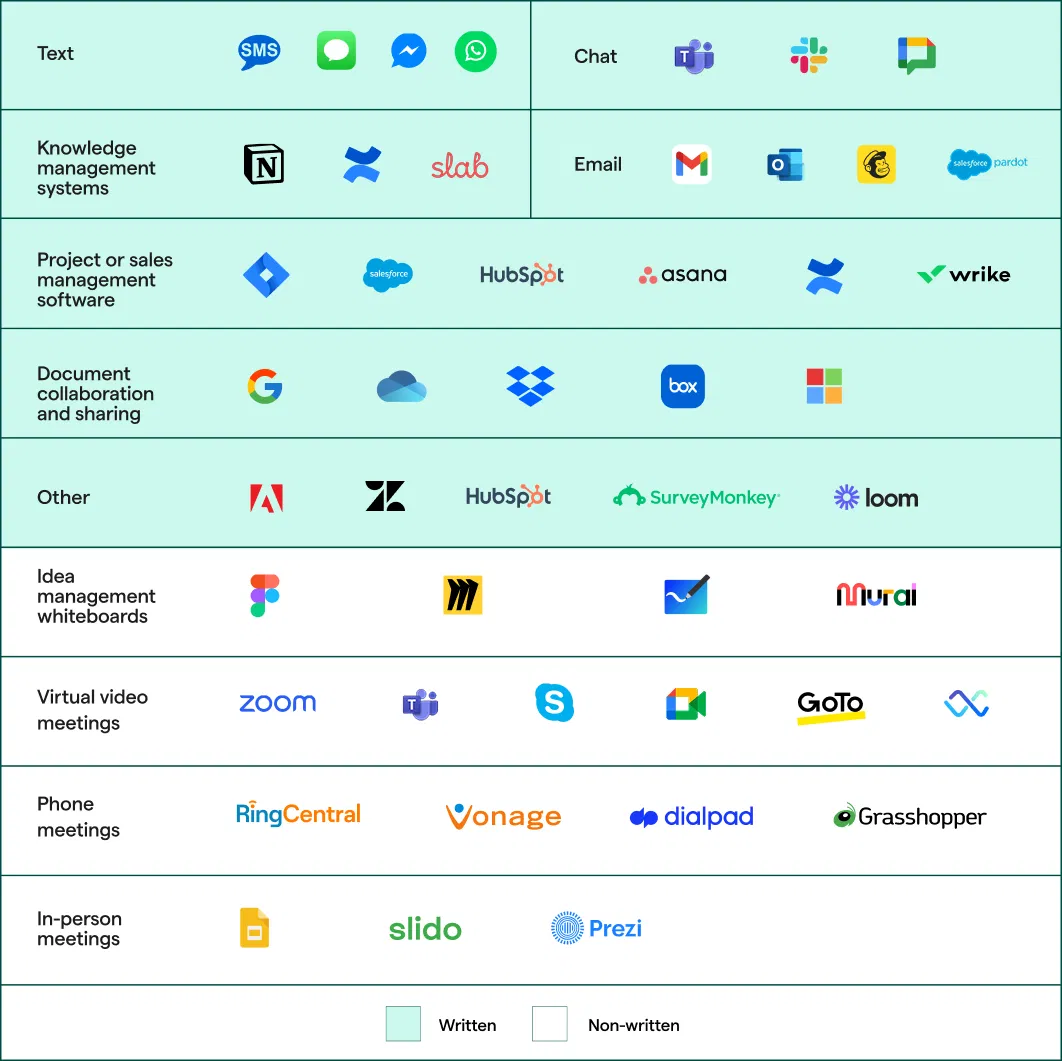

Grammarly helps professionals communicate better and faster by providing context-aware assistance directly at the point of communication, anywhere people write, and across the tools they use. Learn how.
Miscommunication in the workplace costs US businesses an estimated $1.2 trillion every year.
Blocking Success:
The Barriers to Effective Communication


What is it
Ambiguous messages that can lead to misunderstandings and misinterpretations

What to watch out for
Unclear expectations, vague instructions, or incomplete information

How to address it
- Encourage employees to ask questions and seek clarification
- Invest in an AI writing assistant that helps with clarity, conciseness, tone, and organizational context
Overcoming communication barriers and enabling effective business communication is not just important; it’s foundational to your company’s success. Often, leaders believe that their company communicates more effectively than it actually does. This disconnect is highlighted by a substantial 24-percentage-point gap between leaders and employees, where 87% of business leaders perceive their organization’s communication as “highly effective,” compared to 63% of knowledge workers who do.
You should think of effective communication as an essential business strategy, one that takes a comprehensive and proactive approach to ensure standardization across your organization. Here are the steps you should consider to
enable effective communication org-wide:
5 Steps to Standardize Your Enterprise Business Communication Strategy

Establish clear communication guidelines
Develop and communicate clear policies and guidelines for communication within your company. This should include expectations around communication channels, frequency, tone, language, and etiquette to ensure consistency in all interactions. Provide support and resources, like a brand style guide, for all employees, including those working remotely or in dispersed teams. This can help to address communication breakdowns between teams and help everyone unify around a shared language and expectations.

1
Provide training, development,
and resources
Offer training programs, workshops, and tools that facilitate effective communication and help to upskill employees. Provide guidance on active listening, conflict resolution, giving and receiving feedback, and cross-cultural communication to enhance interpersonal interactions and collaboration.
2
Offer the right communication channels
Provide a variety of communication channels and platforms to accommodate different preferences and needs and facilitate collaboration. But watch out for tool overload. Every tool should serve a specific purpose that all teams are aware of. Plus, it’s important to not only invest in tools that improve where you communicate, but also look for tools that will enhance how you communicate.
3
Invest in a unified communication layer
Too many companies are investing in tools that help them communicate more when they really need to invest in a unified communication layer that aligns business communication across channels. An AI-powered communication assistant helps to enhance communication no matter where your employees are working. Look for a ubiquitous solution that can be customized to your brand guidelines, and that tailors results to your organization’s context, tone, clarity, and fluency to create more consistent and effective communication across the entire company.
4
Evaluate and adapt
Continuously evaluate the effectiveness of communication efforts, measure the ROI of your tech stack, and solicit feedback from employees to identify areas for improvement. From there, you can adjust your communication strategies, channels, and practices based on feedback and changing needs to ensure ongoing improvement and alignment with business goals.
5
Achieving effective communication across your business is more attainable than you might think. With trusted and innovative communication assistant technologies at your fingertips, you can standardize effective communication across every level, department, and location of your business. Look for an enterprise-grade AI-powered writing assistant like Grammarly for Business that leverages responsible AI to unlock new levels of productivity across teams.
The productivity savings in effective communication is staggering. Generative AI saves workers an average of 8 hours a week in productivity when used for communication. This represents an estimated total economic impact of $1.6 trillion in the US alone.
Talk about information overload! If you’re feeling overwhelmed, you’re not alone. Businesses all over the world are facing the same challenge. But now you have the roadmap to move forward confidently to enable better business communication at scale.

Grammarly is the trusted AI assistant for communication and productivity, helping over 40 million people and 50,000 organizations do their best work. Companies like Atlassian, Databricks, and Zoom rely on Grammarly to brainstorm, compose, and enhance communication that moves work forward. Grammarly works where you work, integrating seamlessly with over 500,000 applications and websites.
Learn more at grammarly.com/about
About Grammarly
